Compressed Properties
Large text values that queries rarely read (a CV, a product description, a document body) can take most of a graph's memory. A compression rule names where such values live (an element kind, a label and a property path) and the graph keeps the strings there LZ4-compressed in memory. A traversal that reads one gets the plain string, decompressed on the fly; the graph never holds a decompressed copy. Nothing else changes: queries, results, change sets, exports and files see plain strings only.
// Strings of `customer` vertices at `details.career.cv` (and their `bio`) are kept compressed.
g.define_compression(#{name: "customer_cv", label: "customer", path: "details.career.cv"});
g.define_compression(#{name: "customer_bio", label: "customer", path: "bio", min_bytes: 512});
// An edge rule.
g.define_compression(#{name: "order_notes", element: "edge", label: "bought", path: "notes"});

g.v().has_label("customer").values(jpath("details.career.cv")).limit(1)   // plain text
g.compressions()                                                         // the rules and their stats
g.memory_usage()                                                         // compressed_values, ...
When it pays off
- Long strings (hundreds of bytes and more) that are written once and read seldom: CVs, descriptions, notes, logs, document bodies. Typical text compresses to 40 to 55 % of its size (measured below); highly repetitive text much further.
- Not for short strings (names, codes): a value is compressed only when it is at least
min_byteslong (default 256) and its compressed form is at most 90 % of the plain size; everything else stays plain.
The cost model
- A read decompresses.
values(),value_map(),element_map(),project().by(),order().by(), a jpath read, a result: each decompresses the value it reads (about 1.5 to 3 GB/s, below). A read that never touches the field costs nothing. - A filter on such a field decompresses every candidate.
has("bio", TextP.containing("Rust"))reads the text of every vertex it tests; there is no index on compressed fields. Filter on other properties first. - A write compresses a string at a rule path (with the rule's dictionary). Only the touched top-level property is looked at; with no rule for the element's labels a write costs one lookup.
- The disk stays plain. Snapshots, the write-ahead log, GraphSON and GraphML hold the plain text: the persistence layer compresses whole chunks and large WAL records already, compressing single values twice would only cost CPU. A load compresses the rule paths again in one pass.
Rules
A rule is a definition of kind compression in the graph's catalog, next to the saved queries. It
has:
| Field | Meaning | Default |
|---|---|---|
name | an identifier, unique among the rules | required |
element | "vertex" or "edge" | "vertex" |
label | the label the rule applies to (it need not exist yet) | required |
path | a property name or a jpath of names: "cv", "details.career.cv", jpath("$['a b'].c"); no index ([0], [-1]): arrays are not compressed in this version | required |
codec | "lz4" (the only codec of this version) | "lz4" |
min_bytes | strings shorter than this (UTF-8 bytes) stay plain; 1 to 16 MiB | 256 |
dictionary | build a dictionary from the rule's values | true |
- Any number of rules: several paths on one label, the same path on different labels, vertex
and edge labels. One rule per element kind, label and path: a second one is refused
(
DefinitionError::Conflict, its help namesdrop_compression). - Several labels of one vertex: every label's rules apply; when two labels have a rule for the same path, the first label in label order wins (the same rule as schema coercion).
- A label change (
add_vertex_label/remove_vertex_label,set_edge_label) compresses what a new label's rules cover and decompresses what no rule covers any more. - Only strings are compressed. A number, an object or an array at a rule path stays as it is.
The explicit pass
Defining a rule, redefining it with other parameters, dropping it and loading the catalog run the
pass over the rule's label in the same commit: every value at the old and the new path is
re-encoded (compressed when it qualifies, decompressed when it no longer does). g.recompress(name)
runs it again on demand and rebuilds the dictionary, for example after much data was added to a
rule that was defined on an empty label. The pass changes no data: a commit hook sees only the
SetDefinition of the rule, and a recompress alone commits nothing.
Dictionaries
With dictionary: true the pass builds a dictionary from a sample of the rule's current values (in
id order, up to 1 KiB of each value, up to 64 KiB, the LZ4 window) and compresses with it, which
helps short and similar texts most. A dictionary is in memory only: a load builds it again. A value
written before a dictionary exists (a rule on an empty label) is compressed without one until the
next recompress or load. Every compressed value carries its dictionary, so it stays readable when
the rule changes.
API
| Define | List | Drop | Recompress | |
|---|---|---|---|---|
| Rhai (both spellings) | g.define_compression(#{..}) | g.compressions() | g.drop_compression(name) | g.recompress(name) |
Rust (GraphTraversalSource) | define_compression(name, CompressionDefinition), set_definition(Definition::compression(..)) | list_definitions(Some(DefinitionKind::COMPRESSION)), compression_stats(name) | remove_definition(DefinitionKind::COMPRESSION, name) | recompress(name) |
Python (Graph) | define_compression(name, label, path, element="vertex", min_bytes=256, dictionary=True) | compressions() | drop_compression(name) | recompress(name) |
| Playground | Catalog ▾ ▸ Compression: the rules with their stats, a form with field errors | |||
| Dev server | POST /api/compression/define | GET /api/compression | POST /api/compression/drop | POST /api/compression/recompress |
| MCP | define_compression | list_compressions | drop_compression | recompress |
g.compressions() lists each rule with compressed_values, plain_bytes, stored_bytes and
dictionary_bytes. g.memory_usage() (and MemoryStats) adds compressed_values,
compressed_plain_bytes, compressed_stored_bytes and compression_dictionary_bytes;
property_bytes counts the compressed (stored) size.
#![allow(unused)]
fn main() {
use graphersal::prelude::*;
use graphersal::{catalog::CompressionDefinition, storage::ElementKind};

let mut graph = TraversalGraph::new();
let rule = CompressionDefinition::new(ElementKind::Vertex, "customer", "details.career.cv")
    .unwrap()
    .with_min_bytes(512)
    .with_dictionary(false);
graph.traversal_mut().define_compression("customer_cv", rule).unwrap();
}
Authorization: a rule is the resource Definition { kind: compression, name }: define asks
Create (Update when it replaces one), drop Delete, recompress Update, listing Read. No data
request is made (the logical data does not change). AccessPolicy::read_only(), the MCP read-only
mode and a saved query (which always runs read-only) cannot change rules.
The catalog file: rules travel with the saved queries in one catalog file
({"definitions": [..]}, the playground's Catalog ▾ ▸ Save catalog, the dev server's
GET /api/catalog/export); loading it stores the rules and compresses their values at once. A
snapshot and a Store carry the catalog, so a rule survives every store operation (WAL replay,
checkpoint, fork, backup, restore, repair, rollback); the files hold plain values, and the load
compresses again. A version that does not know the kind keeps the rule unchanged and only loses the
compression (the definition is not critical).
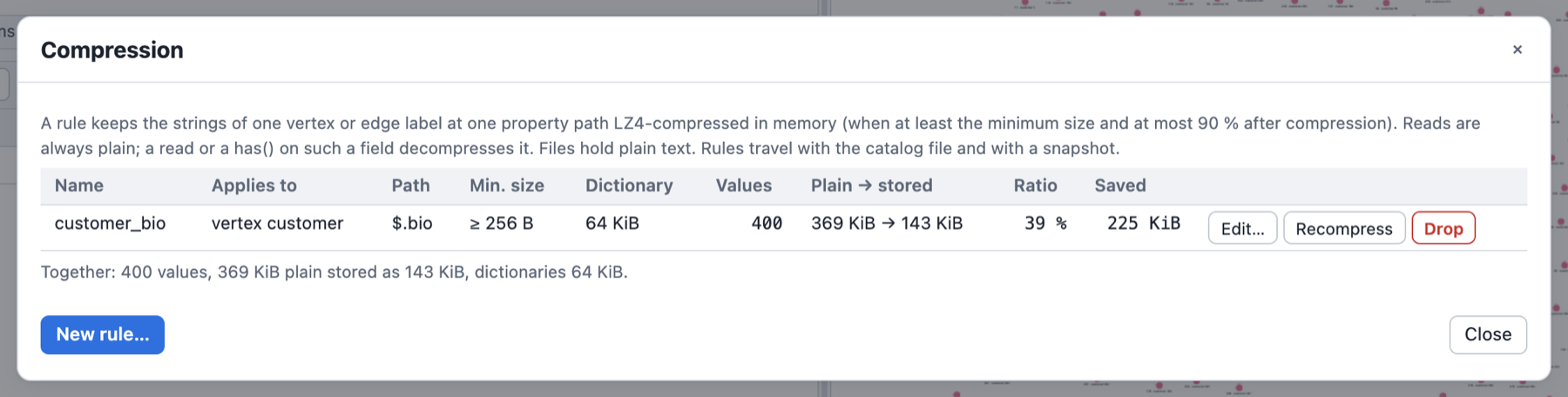
In the playground, Catalog ▾ ▸ Compression lists the rules with their statistics (here 400 customer biographies, about 1 KiB each) and defines, edits, recompresses and drops them:
Measured
On a generated CV-like corpus of 5,000 texts of 2 to 20 KB (55 MB: section headers, sentences
from a 200-word vocabulary, company names, years and numbers), Apple M-series, --release
(compressed_property_tests::measure_ratio_and_throughput, an #[ignore]d test):
| Stored / plain | Dictionary | Define pass (compress) | Read (decompress + materialize) | |
|---|---|---|---|---|
| LZ4 | 0.52 | none | 451 MB/s | 2,741 MB/s |
| LZ4 with dictionary | 0.42 | 64 KiB | 328 MB/s | 1,626 MB/s |
The compression figures include a round-trip check of every value (a compressed value is verified once when it is made, so reading it back cannot fail). A highly repetitive corpus (a dozen phrases recombined) compresses to 0.07 (0.05 with a dictionary).